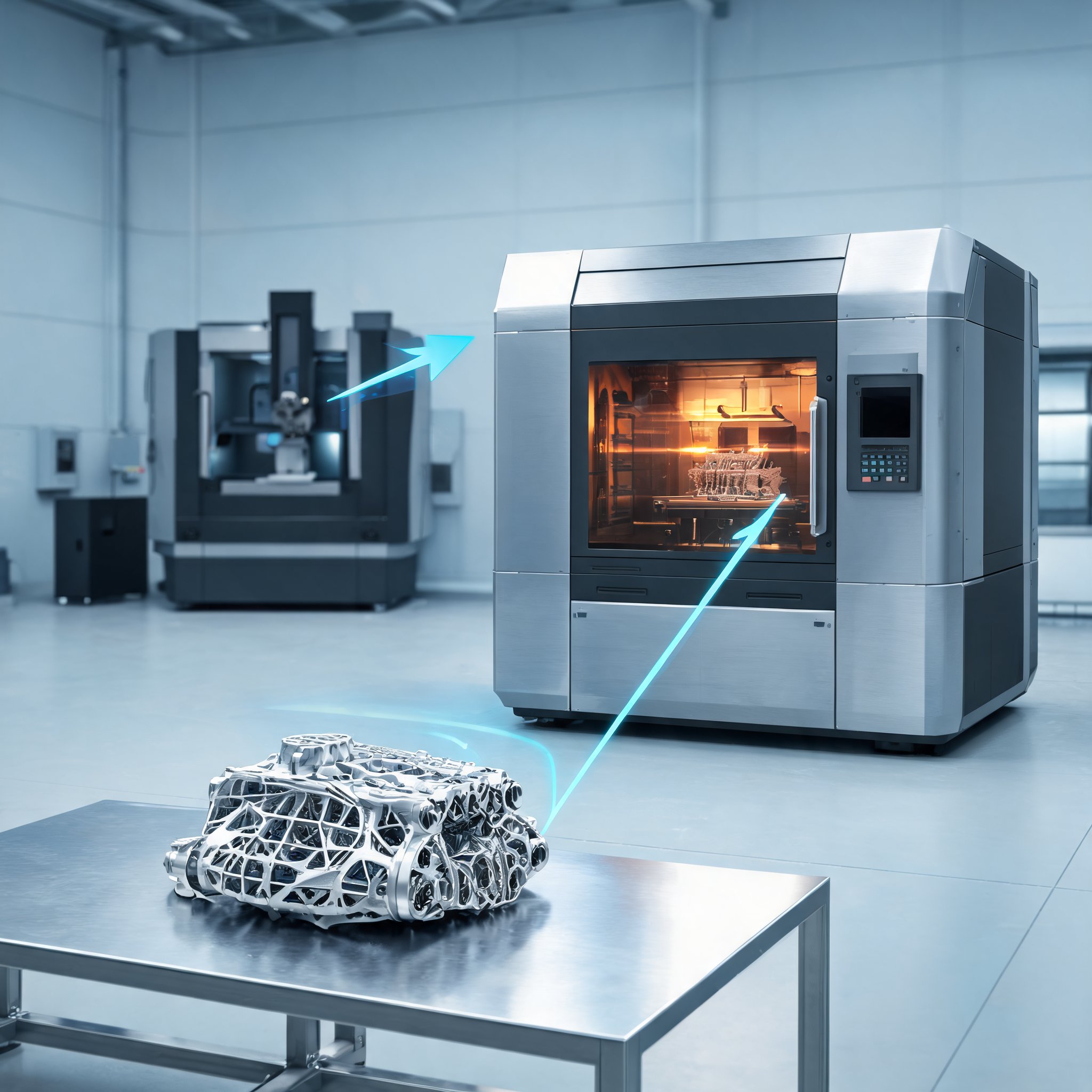
For 3T-AM, the hard part of additive manufacturing is no longer proving that a metal component can be printed. It is repeating the same component for the same customer at an agreed price and on schedule. Commercial director Eddie Andrews, who joined the Newbury manufacturer in November 2021, frames the problem bluntly: the company knew how to make one-off parts for hundreds of customers, but had to learn how to make that work “boring” enough to become general manufacturing.
Five years later, the mix has shifted. Andrews estimates that around 70% of revenue now comes from production, while new product introduction still takes up roughly 80% of the team’s time. That gap is the central tension in 3T-AM’s move from prototypes to serial supply: repeat orders pay the bills, but development work still consumes most of the organisation’s attention.
From accumulated processes to a production owner
3T-AM dates its business to 1997 and received its first metal machine around 2008. By the 2021 reset, years of accommodating individual prototype jobs had left the shop floor with “process after process after process,” as Andrews describes it. The company narrowed its customer base, gave larger accounts more influence over what it developed and simplified procedures that had accumulated. Much of the work remained manual while the team established which operations it could reliably repeat.
The change was not only about equipment. Responsibility for a job also moved. Previously, the first person to see a drawing was the engineer responsible for printing it, so the natural question was “how am I going to print it?” Decisions taken at that point shaped the work handed to everyone else. Today a product owner is responsible for delivering the finished component, and print and machining specialists agree what condition the part should be in as it passes from one operation to the next.
Machining and machine capacity as one system
Andrews’s argument is that additive production cannot be judged in isolation from downstream processing. “To become a successful additive manufacturer, you need to be a really good CNC machining company,” he says. Bringing machining in-house gave the SME more control over costs, quality and delivery dates. Larger multi-laser machines improved productivity at the printing stage. Neither investment on its own, however, could tell a customer when a finished part would arrive.
The commercial transition has been harder to time than the technical one. Production orders rose and then tapered off. Turning away too much prototype work during the upswing would have left gaps when demand eased. Repeat orders now give 3T-AM room to choose which development jobs to take, even though some will never become production contracts. As Andrews puts it, if a manufacturer does not take part in the journey, it will never find out what a development job could become.
Order book before capital
The ownership change adds another layer. Austrian precision manufacturing group SBO acquired 3T-AM in October 2025. The Newbury business had generated around £5 million in sales in 2024. SBO brought experience in machining downhole drilling equipment, including components up to ten metres long, and was interested in 3T-AM’s metal printing expertise and access to a different set of industrial customers.
SBO approved a five-year business plan and asked whether it could be done quicker. In August 2026, the group reported that 3T-AM had added an EOS M400 in the second quarter, ordered another printer and invested further in post-processing. Those purchases formed part of a seven-printer expansion across UK and US operations. A full order book makes the next machine easier to justify, but it also leaves little time on that machine to qualify a different material or develop a new product. Andrews wants to preserve two distinct reasons to invest: contracted demand and work that 3T-AM cannot yet offer.
The scale of some production commitments explains why capital alone is not the whole answer. Andrews recalls a pre-pandemic aerospace enquiry in which a single family of parts would have required 16 multi-laser systems to cover only a share of the requirement. From the buyer’s side, the question was how many suppliers had the floor space, the capital and the capacity to take it on. He sees that as one reason original equipment manufacturers still keep sizeable additive programmes in-house.
What the customer can measure
For some customers, replacing a casting with a printed part earns its keep through lead time alone. A legacy or development programme can obtain a component sooner, even at much the same unit cost. At higher volumes the calculation gets tougher. Machine maintenance contracts and consumables weigh on the hourly rate, and a factory working a single shift has fewer productive hours over which to spread those costs. Andrews sees scope to learn from CNC shops that operate around the clock, with support removal one place to look for automation because the process can still depend on what an experienced operator knows about a particular job.
A project with Honeywell Aerospace will put another claim to the test. Under an Aerospace Technology Institute-funded programme, the partners are converting an existing conventionally manufactured component to additive. The sustainability team at the NCC in Bristol is carrying out a 12-month life-cycle assessment covering manufacture, service and end of life. Printing closer to the finished shape should use less feedstock and leave less metal to machine away than starting with billet. The study will compare the two manufacturing routes alongside any benefit the redesigned component delivers in service.
The intended outcome in Newbury is something a purchasing department could use. As 3T-AM connects its factory and enterprise systems, it is developing digital product passports to document the carbon associated with making an individual component. By the end of 2028, Andrews wants that information to come with every part at no extra charge. For a customer compiling a supply-chain emissions report, it would become one more thing they could expect from a routine order. The transition from prototypes to production therefore depends on making repeatability visible: in delivery dates, in agreed part condition between operations and, eventually, in the carbon data attached to each order.