Justin Lombardoni, the ornamental plant breeder at the Chicago Botanic Garden, used a July speaking slot at the Perennial Plant Association's National Symposium in East Lansing, MI, to draw a line between his program and the commercial breeders who shared the session. To his knowledge, it is the only breeding program housed at a botanic garden in the United States — a position, he argued, that changes which plants get bred and which traits get pursued.
Native first, with a regional definition
Native species get priority in the program, though not exclusively. Lombardoni noted that “native” carries different standards depending on who is applying it: some define it by county, others by state or region. He favors the regional view, reasoning that plants do not recognize the artificial borders drawn between counties or states, particularly where no physical barrier keeps them from spreading.
When an exotic genus is under consideration, the program screens it on two seed-related factors that feed invasive potential: fecundity, or how much seed a plant produces, and dispersal, or how readily that seed travels, whether a few feet or much farther. Vegetative spread through rhizomes, stolons and suckers counts as well. Kudzu, the vine Pueraria montana, he offered, is an extreme reminder of what happens when a plant's ability to spread is underestimated.
Niche genera instead of crowded markets
Limited space and resources mean the program cannot go head-to-head with larger commercial operations, and Lombardoni said there is little point in trying. Many mainstream genera are already saturated with dozens, if not hundreds, of cultivars. He questioned the value of another Echinacea or Hosta when comparatively esoteric genera remain largely untapped.
Traits the program steers away from
Rather than list preferred traits, which vary widely by genus, Lombardoni described what the program avoids. Chief among them is the highly compact cultivar, a fixture of industry breeding for the past decade or two because such plants look good in pots and ship efficiently. He defined compact as roughly 30 inches or shorter and drew a distinction between reining in the size of an unruly species and releasing a cultivar half the height, or less, of its parent species.
Sterility is also off the table, including the “double” flower forms common in ornamental horticulture, where extra petals replace pistils or stamens and can reduce available pollen or make floral resources harder for pollinators to reach. More broadly, the program does not pursue cultivars whose traits undercut their ecological function.
‘Summer Snow’ as a working example
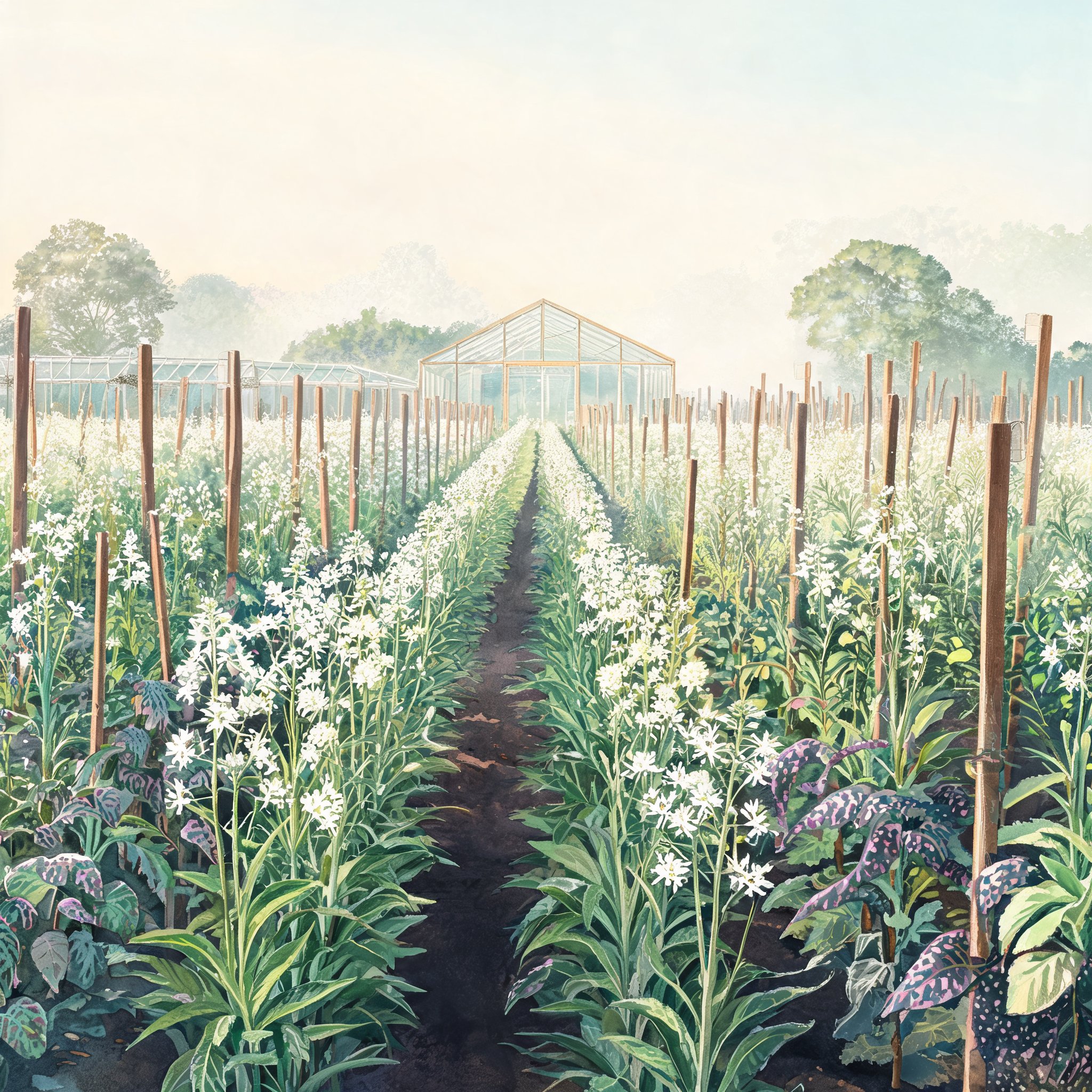
Eutrochium maculatum ‘Summer Snow’, released about a decade ago, illustrates the approach. Its germplasm was collected roughly 90 miles from the Garden, three counties away, yet Lombardoni still counts it as a native selection because the species itself is native to the Garden's county. At about 5 feet, it is not substantially shorter than the straight species, and its upright stems carry white flowers that serve pollinators from mid-to-late summer.
Pollinator performance as a breeding question
Pollinator support matters to many home gardeners, and Lombardoni said the program hopes to collaborate with the Garden's Science Department, which is partnered with Northwestern University, to measure pollinator visitation to its breeding selections against straight species, comparing the abundance and diversity of visitors between the two.
Aesthetics inevitably weigh heavily when perennials are bred for the commercial market, especially how a plant reads in a pot, and ecological function may not receive equal emphasis. Because the Garden is a nonprofit, Lombardoni said, his team faces no target number of cultivars to release each year and no mandate to maximize sales of any single one. That, he suggested, is what allows a different kind of perennial breeding — and, he hopes, gardens that do not end up composed entirely of plants 2 feet tall or shorter.