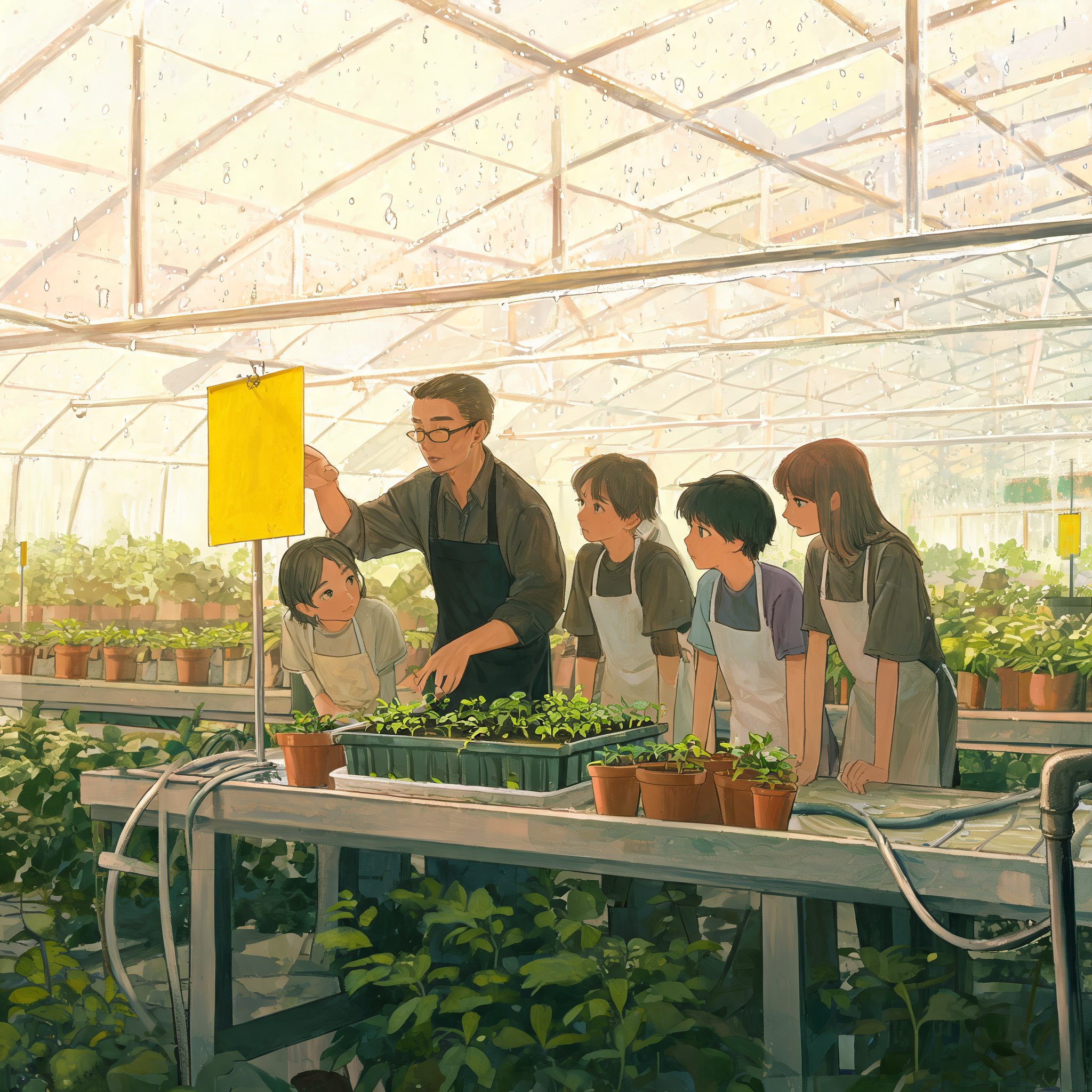
High-school vocational horticulture could become one of the greenhouse industry's most effective recruiting pipelines, if commercial growers help build it, argues Jeff Neese, a Biological Solutions Advisor for BioWorks who works with growers across the Great Lakes region.
His case comes from his own start. He recalls walking into the greenhouse at Warren Central High School in Indianapolis, where Indiana was cold and gray outside and warm, humid and alive inside. Vocational horticulture was available there, taught by Phil Pitts, a grower and landscape designer, and Pam Greene, who taught floriculture.
Students were not there to memorize plant names, he writes, but to understand plants and learn to grow them well — which meant weekend watering, and insects and diseases that do not wait for Monday.
Neese skipped college and went straight into horticulture; more than 40 years later he is still in it. He says that does not diminish university training, which the industry needs. His point is narrower: college should be neither the first place a young person meets horticulture nor the only respected route into it.
The workforce conversation, he argues, starts too late. The industry talks about the difficulty of finding growers with practical production experience, about succession planning and recruiting graduates, but seldom asks where a 15- or 16-year-old is supposed to discover the field. Someone has to show them.
What a school greenhouse needs
A greenhouse behind a school is not enough by itself, in Neese's view. He calls it a living laboratory whose operation demands knowledge, commitment and time, and says it is unrealistic to expect agriculture teachers, who cover broad subject areas, to also be accomplished growers, crop schedulers, irrigation specialists, diagnosticians, IPM practitioners and environmental-control experts.
His proposal is that commercial operations essentially adopt their local school greenhouses — not to take the greenhouse from the teacher or dictate curriculum, but to serve as a technical resource: helping develop an achievable crop plan, setting realistic standards for irrigation, fertility, pH, EC, temperature and crop timing, and walking the plants with students to teach scouting rather than simply naming what is wrong. Growers could demonstrate sticky cards, root examination and nutritional diagnosis, and stay available when something goes wrong.
Why summer alone falls short
Summer internships matter but are not enough alone, he writes. Summer is usually the only extended period when high-school students can work full time, and much of spring's activity may already be past. As inexperienced seasonal employees, students can end up with whatever job nobody else wants that day — sticking poinsettias, spacing crops, moving plants or cleaning houses.
Those tasks are legitimate parts of commercial horticulture, he says, and every good grower should understand the physical work. But a teenager who experiences only that has seen greenhouse labor, not greenhouse management. Understanding growing requires the whole year — fall crops and shortening days, winter's low light, spring propagation and the controlled chaos of peak production, summer heat and irrigation. An eight-week internship gives a snapshot; learning horticulture requires the whole movie.
He suggests school and commercial greenhouses function as extensions of one another. Students who studied pH and EC should see commercial monitoring; those who learned scouting and IPM should walk crops with the person responsible. Even repetitive work becomes instruction when the decisions behind it are explained — where a cutting fits in the schedule, what happens during rooting, when the crop will be transplanted and why the finished-crop date matters. We have not eliminated the work, he writes; we have turned it into learning.
Recruiting earlier
The relationship doubles as recruiting. A student might meet a company as a sophomore, visit the greenhouse as a junior, then keep building skills at school as a senior, so the career path is visible at graduation. Neese says some of the most rewarding growers he has worked with are people he helped grow himself.
College is the right next step for many students and should be encouraged, he writes, but those who cannot attend, or do not want to, should have another respected path. An 18-year-old with vocational horticulture, commercial exposure and mentorship should not be seen as unskilled labor.
His advice to growers is concrete: find the agricultural education or horticulture program in your community, meet the teacher, walk the school greenhouse and ask what they need, offering knowledge rather than only old equipment and leftover plants. Invite students in during February as well as June, let them scout, test EC, examine roots and make mistakes. When they arrive for the summer, give them a reason to want your job someday.
The future of horticulture, Neese concludes, may already be sitting in a high-school classroom. We just have to help grow them.