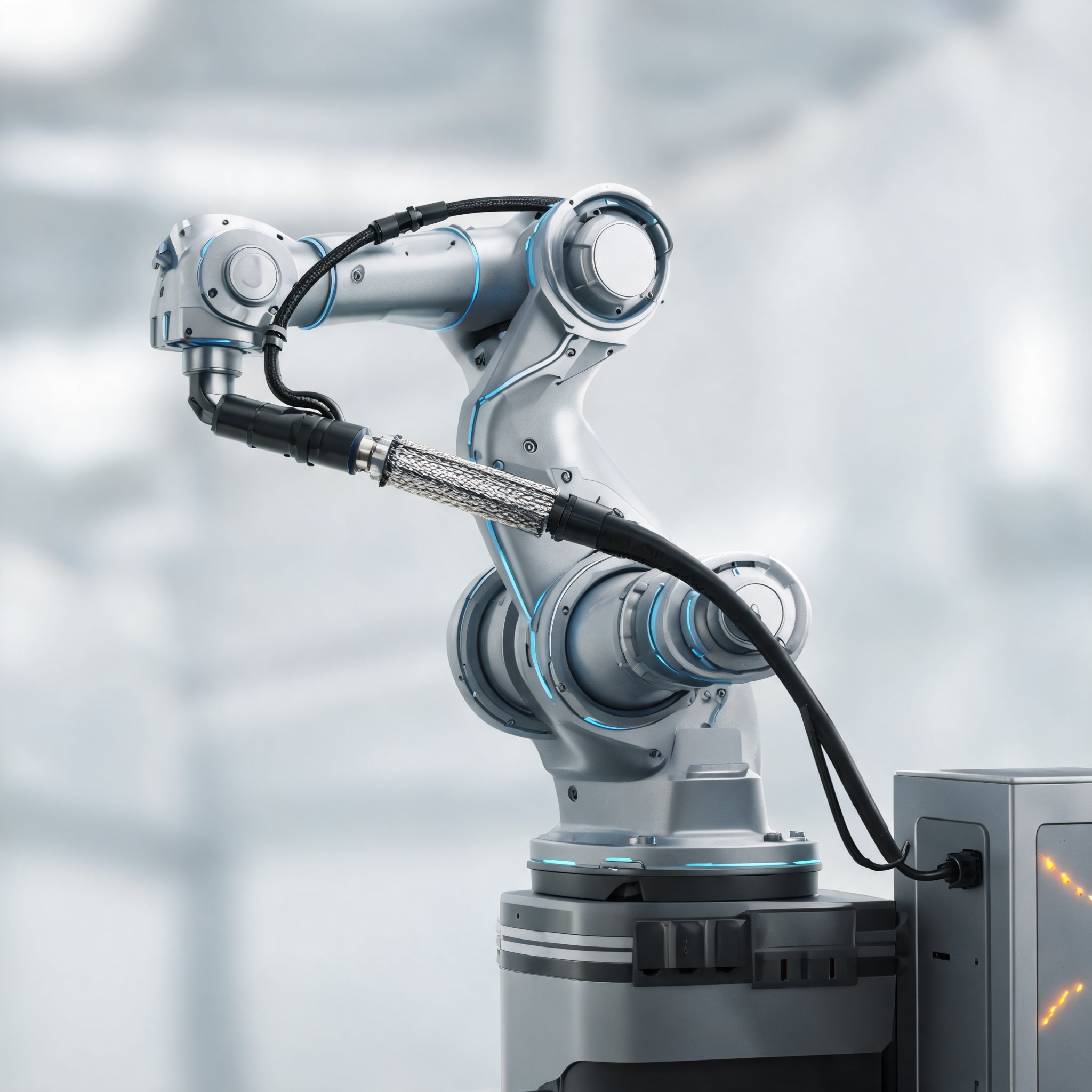
Igus has added a DeviceNet cable to its CFROBOT8.PLUS family of robot cables, extending the range to another industrial communication protocol used in dynamic robotic applications. The new cable is designed to withstand torsion of up to ±360° per meter, according to the company, and is aimed at continuous movement rather than static installation.
The CFROBOT8.PLUS family is engineered for up to 10 million torsional cycles. Igus attributes that capability to a specialized shield design intended to preserve flexibility during repeated robotic motion. The new DeviceNet variant also has a reduced outer diameter, up to 21 percent smaller than previous CFROBOT8 models, which the company says makes it easier to route in tight spaces.
Shield and environmental protection
A tinned-copper braided shield is used to help maintain signal integrity under demanding conditions. The cable also carries oil and UV resistance, allowing it to be used in both indoor and outdoor environments. Those attributes matter in robotic installations where cables may be exposed to lubricants, sunlight or other stressors while continuing to flex.
Igus lists six-axis robots, handling systems, machine tools, linear and lead screw systems and other applications with continuous torsional movement as suitable uses. The DeviceNet version therefore joins a family that already covers several industrial communication standards. According to Igus, CFROBOT8.PLUS cables are available for PROFINET, PROFIBUS, CAN bus and Ethernet applications up to CAT7, giving users options across a range of industrial communication systems.
Testing in simulated motion
Like all chainflex cables, the CFROBOT8.PLUS products are tested in Igus’s 5,500-square-meter laboratory under simulated real-world robotic motion. The company says testing has demonstrated reliable electrical performance through more than 15 million cycles. These are manufacturer test results, not an independent certification, but they provide context for how the cable is positioned: as a component for repeated movement in automated equipment rather than a general-purpose fixed-installation cable.
For designers, the new DeviceNet option adds a communication cable to a family already focused on robotic torsion. The combination of a smaller diameter, shielding and environmental resistance is intended to address routing constraints and signal reliability in the same package. The core claim is that the cable can support continuous torsional movement while maintaining electrical performance in demanding robotic environments.