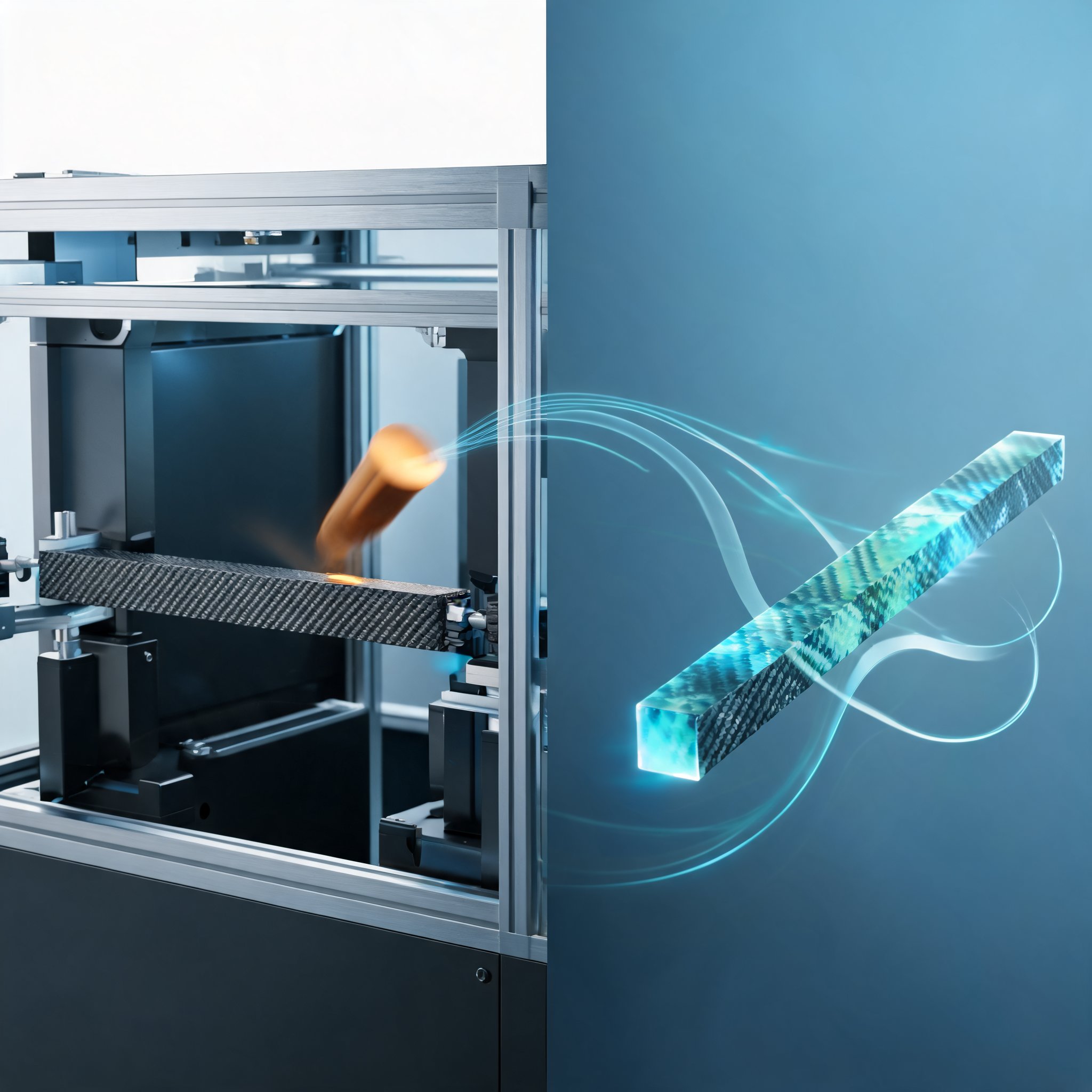
Material data gathered at high loading rates can make crash and impact simulations more representative and give engineers a firmer basis for choosing materials, according to Andrea Incardona, application engineer and product specialist at Instron, the high strain rate testing machine manufacturer. In an article setting out the case, Incardona argues that the value of a simulation depends less on how much material data is available than on how closely that data reflects the conditions a component will actually meet.
Strain-rate dependence and model fidelity
Many materials show strain-rate-dependent behaviour, meaning their mechanical response changes as loading speed rises. A material characterised only under quasi-static conditions may therefore respond differently when it meets a rapid impact or a crash event. Incardona cites a 2025 study published in the SAE International Journal of Materials and Manufacturing, "Influence of Strain Rate Effect on Mechanical and Crashworthiness Properties of CFRP Composite Structures", which found that feeding strain-rate-dependent properties into crash simulations narrowed the gap between simulated and experimental results. The discrepancy in peak acceleration fell by 6.5 per cent, while mean acceleration and displacement discrepancies fell by 5.9 and 6.3 per cent respectively.
According to the article, materials can be characterised from quasi-static conditions up to strain rates approaching 1,000/s, with the reachable range depending on the material, the specimen geometry and the test method. Such tests may last only 3 to 10 milliseconds, so the data acquisition system has to resolve very fast changes in force and deformation.
Where strength, stiffness, deformation mechanisms or failure behaviour shift as strain rate increases, the article states, a model built solely on conventional data may be unable to represent what happens during a rapid event.
Material selection and weight trade-offs
Conventional strength and stiffness values do not necessarily show how a material will behave when loading becomes rapid, and two materials that appear comparable in standard tests may diverge under high strain rate conditions. Characterising dynamic behaviour allows engineers to compare how candidate materials deform, absorb energy and ultimately fail. Incardona says this matters most where performance has to be balanced against weight, citing automotive crash structures and aerospace components, because dynamic data adds a further layer alongside mechanical properties when judging the trade-off between weight, strength and energy absorption.
Earlier in the development cycle
The article describes a development sequence in which material behaviour is measured, incorporated into simulation, used to compare design options and then validated through physical testing. On this account, testing becomes more than a final check on an existing design, since dynamic data can be used earlier to judge whether a material is suitable, to refine a component and to understand how changes may affect performance.
Data capture is presented as the enabling requirement. Instron states that its high strain rate systems support data acquisition at up to 200 kHz, and that digital image correlation can add information about strain development across the specimen, with analysis tools supporting data processing and theoretical modelling.
Incardona's conclusion is that material data is only as useful as its relevance to the conditions a component will face, and that revealing how materials respond to rapid loading gives engineers a more complete picture of performance from simulation through to product development.