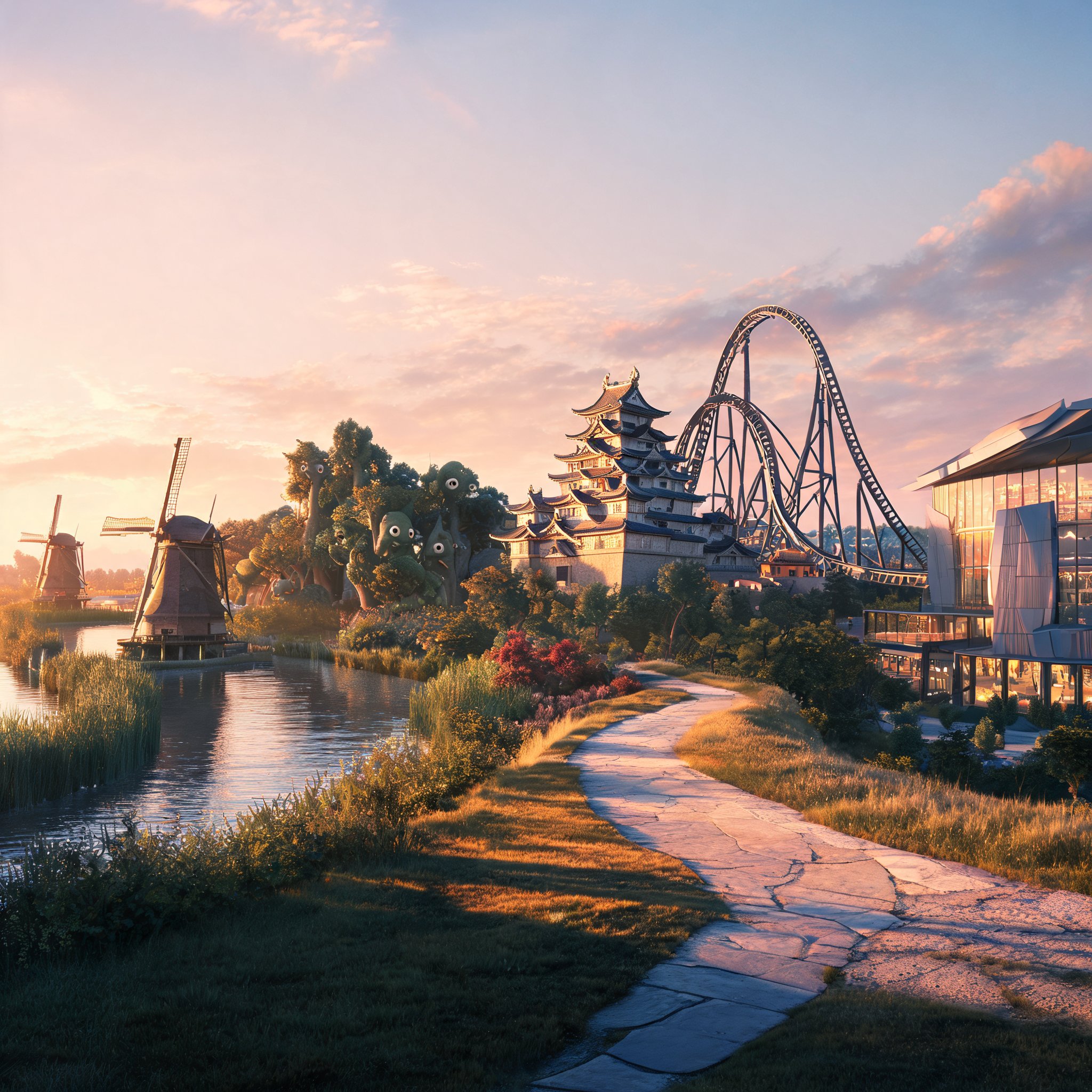
Japan welcomed a record 42.7 million international visitors in 2025, and its theme parks remain a central part of the country’s travel appeal. Operators are expanding established resorts, adding new themed lands and relying on popular entertainment franchises to attract domestic and overseas guests.
Major destination resorts
Universal Studios Japan in Osaka opened in 2001 and includes areas based on Harry Potter, Jurassic Park and Minions. It became the first Universal park to open Super Nintendo World in 2021 and added the world’s first Donkey Kong Country area in 2024. Limited-time collaborations have featured Demon Slayer, Jujutsu Kaisen, Pokémon, One Piece and Resident Evil, alongside seasonal Sanrio shows and parades. In 2026, the park announced its first expansion since 2001, with plans to invest up to 300 billion yen in new attractions across 60,000 square metres of nearby land.
Tokyo Disneyland opened on 15 April 1983 as the first Disney park outside the United States. It features seven themed lands and, with Tokyo DisneySea, is owned and operated by Oriental Land Company under licence from The Walt Disney Company. In 2026, Tokyo Disneyland announced Space Mountain Earthrise and Sugar Rush: Sweet Rescue as part of a 100 billion yen ($630 million) Tomorrowland transformation; the new Space Mountain is due to replace the original coaster in 2027. Tokyo DisneySea opened in September 2001 across 49 hectares, with seven themed ports. Its 2024 Fantasy Springs expansion, costing $2.2 billion, added worlds inspired by Frozen, Tangled and Peter Pan.
Character and IP-driven parks
Ghibli Park, within the Expo 2005 Aichi Commemorative Park, opened in November 2022 with three of its five themed areas; Mononoke Village followed in November 2023 and Valley of Witches in March 2024. It has no major thrill rides, but highlights include a large-scale Howl’s Moving Castle recreation, a My Neighbor Totoro-themed playground with Satsuki and Mei’s House, and Catbus electric vehicles. A new indoor area inspired by Nausicaä of the Valley of the Wind was announced in 2026.
PokéPark Kanto opened in February 2026 at Yomiuriland in Tokyo as the world’s first permanent outdoor Pokémon attraction. The 26,000-square-metre park features more than 600 Pokémon across Pokémon Forest and Sedge Town, plus a parade and two attractions, Pika Pika Paradise and Vee Vee Voyage. Its tickets include admission to Yomiuriland, where more than 40 rides include the Bandit coaster, which reaches 110 km/h. Yomiuriland drew around 2.4 million visitors in 2024 and celebrated its 60th anniversary.
Sanrio Puroland in Tokyo is an indoor park opened in 1990, with Hello Kitty, My Melody and Cinnamoroll appearing in rides, shows and greetings. In 2024, Alterface created Cinnamoroll’s Little Big Adventure for its Discovery Theatre. Sanrio Harmonyland, the outdoor sister park in Hiji, Oita Prefecture, added the Nakayoku Lab area in 2026, including the Sky Pal Collection AR experience.
Thrill and regional parks
Fuji-Q Highland opened in 1968 and is known for record-breaking coasters such as Fujiyama, Eejanaika and Takabisha, along with views of Mount Fuji. It regularly hosts collaborations with anime franchises including Demon Slayer, Evangelion, Gundam and Pokémon. Nagashima Spa Land opened in 1966 and has 13 operating coasters, more than any other Japanese amusement park, including Steel Dragon 2000. It is part of Nagashima Resort, which also includes a water park, hot springs and the Nabana no Sato flower park.
Huis Ten Bosch, opened in 1992 in Sasebo, Nagasaki Prefecture, recreates a Dutch-style town and spans about 152 hectares, making it Japan’s largest theme park by area. In 2025 it opened Japan’s first premium flying theatre with Brogent Technologies, using an 8K LED dome screen, and opened the world’s only Miffy area, Miffy Wonder Square. Legoland Japan opened in Nagoya in April 2017 as Japan’s first Legoland park and the second in Asia. Its Miniland Japan uses more than 10 million Lego bricks to recreate Japanese landmarks.
Historic and smaller attractions
Edo Wonderland Nikko Edomura is a 49.5-hectare cultural park in Tochigi that recreates an Edo-period town, with costumes, theatre shows, ninja performances and activities such as archery and shuriken throwing. Asakusa Hanayashiki, established in 1853 in Tokyo, is considered Japan’s oldest amusement park and still operates a roller coaster built in 1953. Moominvalley Park opened in March 2019 in Hanno, Saitama Prefecture, as the second Moomin-themed park in the world and the first outside Finland.
Other attractions include Sylvanian Park in Ibaraki, a Sylvanian Families-themed site; Greenland in Arao City, Kumamoto, part of a 300-hectare resort with around 80 attractions and a 105-metre Rainbow Ferris wheel; and Hirakata Park in Osaka, which dates to 1910 and has 45 attractions, including the 696-metre wooden coaster Elf and the 1.3-kilometre Red Falcon.