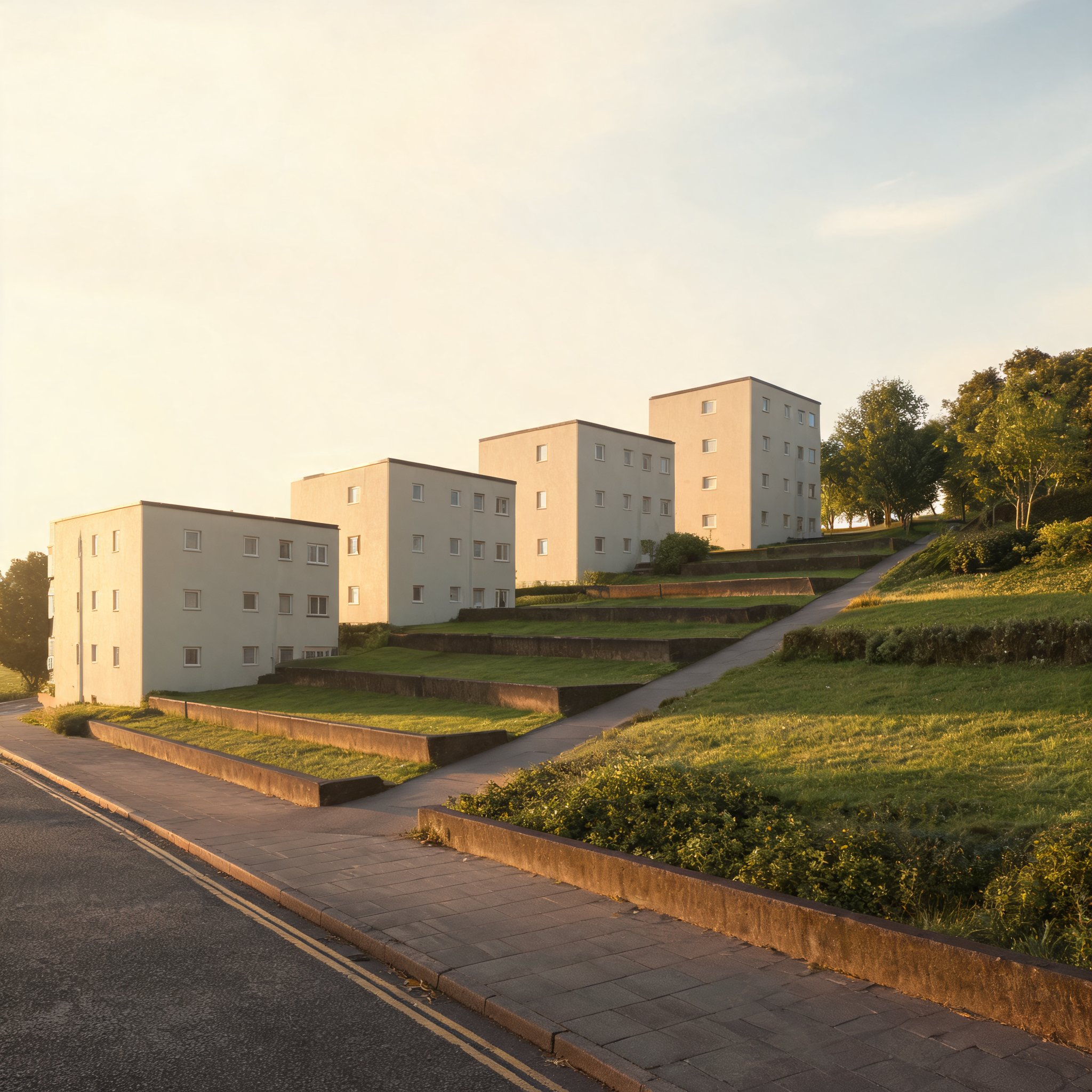
Lion Green Road in Coulsdon, south London, has been awarded the RIBA Stirling Prize 2026. The 157-home development was designed by Mary Duggan Architects with RUFF Architects and built for Croydon Council by main contractor CField Construction under a £34m deal.
The scheme comprises five blocks on the site of a former car park. The land slopes across an eight-metre height difference, and the design uses the changing levels and views to create what the project describes as a new “living landscape” for 635 residents. It also creates a connection between Lion Green Road and a distinctive area of green parkland beyond.
Efficient construction methods, simple finishes and a more streamlined building process allowed the scheme to cut carbon emissions, according to the project. No figure is given for the reduction.
RIBA President Chris Williamson, speaking for the Stirling Prize jury, said the project showed that density could be achieved without compromising the quality of the places created. He highlighted a consistent specification, combined with subtle variation in height and orientation, as a way of providing housing at scale without uniformity.
Williamson described the result as a new kind of garden neighbourhood that balances privacy and generous views with a strong connection to nature. He called it a “living landscape” and said the architects had produced thoughtful, resourceful architecture, proving that even a challenging site could be transformed into a distinctive place for people to call home.
The award places a council housing scheme at the centre of the 2026 Stirling Prize. Its identifiable strengths, as set out in the jury comments, are the handling of an eight-metre level change, the arrangement of five blocks and the attempt to combine density with landscape. The scheme is also presented as an example of how efficient construction and simple finishes can support carbon reduction.
Details such as tenure mix, individual unit sizes, construction programme and energy performance are not included. The carbon benefit is stated without a figure. The account therefore rests on the delivery facts, the design approach and the jury’s assessment rather than on a detailed performance evaluation.
For Croydon Council, the prize gives recognition to a scheme delivered with a main contractor on a constrained urban site. For the design team, the jury comments emphasise the relationship between standardisation and variation, and between housing and landscape. Those themes run through the project description, while cost and environmental claims remain broad rather than quantified.