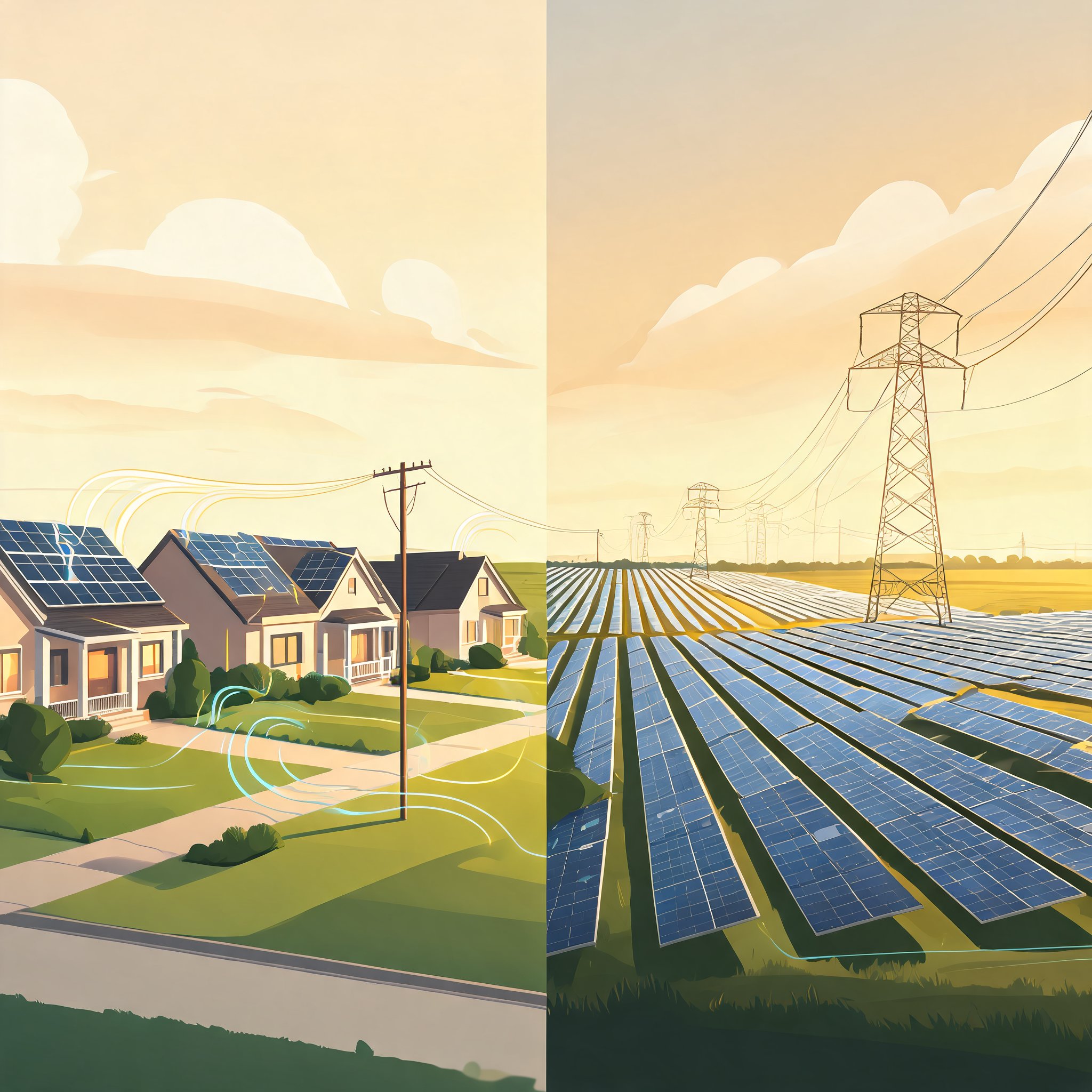
Researchers at the Massachusetts Institute of Technology's Center for Energy and Environmental Policy Research (CEEPR) have concluded that renewable portfolio standards (RPS) and utility-scale renewables are not associated with higher residential electricity prices in the United States — and that rooftop solar is associated with higher prices.
The finding comes from a state-utility panel covering 1998 to 2023, built by Fischer J. Espiritu Argosino and Christopher R. Knittel. The dataset links residential prices, RPS stringency, generation mixes and utility spending, and draws on data from the US Energy Information Administration (EIA), the Federal Energy Regulatory Commission (FERC) and Lawrence Berkeley National Laboratory (LBNL).
What the regressions show
Using a two-way fixed-effects regression model that controls for unobserved differences across years and between states, the authors found that RPSs and utility-scale renewables are not associated with higher residential electricity prices. RPSs had virtually zero impact on prices, they said, while utility-scale renewables were modestly associated with lower prices. Utility-scale solar stood out as strongly linked with lower prices.
Based on the paper's regression coefficients, which measure generation shares relative to coal, a 10-percentage-point rise in utility-scale solar's share of generation is associated with residential prices just over 8% lower. A 5-percentage-point rise in rooftop solar's share is associated with prices roughly 16% higher.
The authors cautioned that the results are correlations and said further work would apply more rigorous econometric techniques to strengthen the causal interpretation of these estimates.
Why utility-scale and rooftop diverge
One explanation offered for the utility-scale result is that large solar plants may reduce network congestion and place downward pressure on overall generation costs because they do not require fuel inputs. A second model, which also controls for differences between utilities, found utility-scale solar strongly associated with lower transmission, distribution and total operation and maintenance (O&M) costs.
For rooftop solar, the researchers suggested tariff design may partly explain the result. Current rate structures in some states shift fixed costs associated with rooftop solar from the owners onto other ratepayers, they said. In effect, those without rooftop solar often fund those who have it through an additional volumetric rate.
Distribution strain
Rooftop solar was also strongly correlated with higher distribution O&M costs. One reason, the researchers said, is that the distribution network was not designed for bidirectional power flows.
CEEPR does not peer-review working papers before posting them.
The researchers argued that policymakers can secure an affordable energy future by improving the integration of low-cost renewables while implementing more equitable cost recovery strategies.
Corroboration and an unsettled dispute
The utility-scale result echoes a June 2025 LBNL study led by Ryan Wiser, which found that the roughly 75% of US utility-scale wind and solar built outside RPS programs had no broadly discernible upward effect on retail prices.
The rooftop solar finding feeds into a long-running dispute over cost-shifting in California. The California Public Utilities Commission's Public Advocates Office has estimated an $8.5 billion cost shift from rooftop solar customers to other ratepayers. A 2025 report by M.Cubed Consulting and the California Solar and Storage Association found instead that rooftop solar delivered a $1.5 billion net benefit to all California ratepayers. Solar advocates have also argued that rising transmission and distribution spending is a larger driver of rate increases.
The researchers described their findings in "Renewables and Electricity Affordability: Untangling Correlation from Causation," published as MIT CEEPR Working Paper 2025-22.