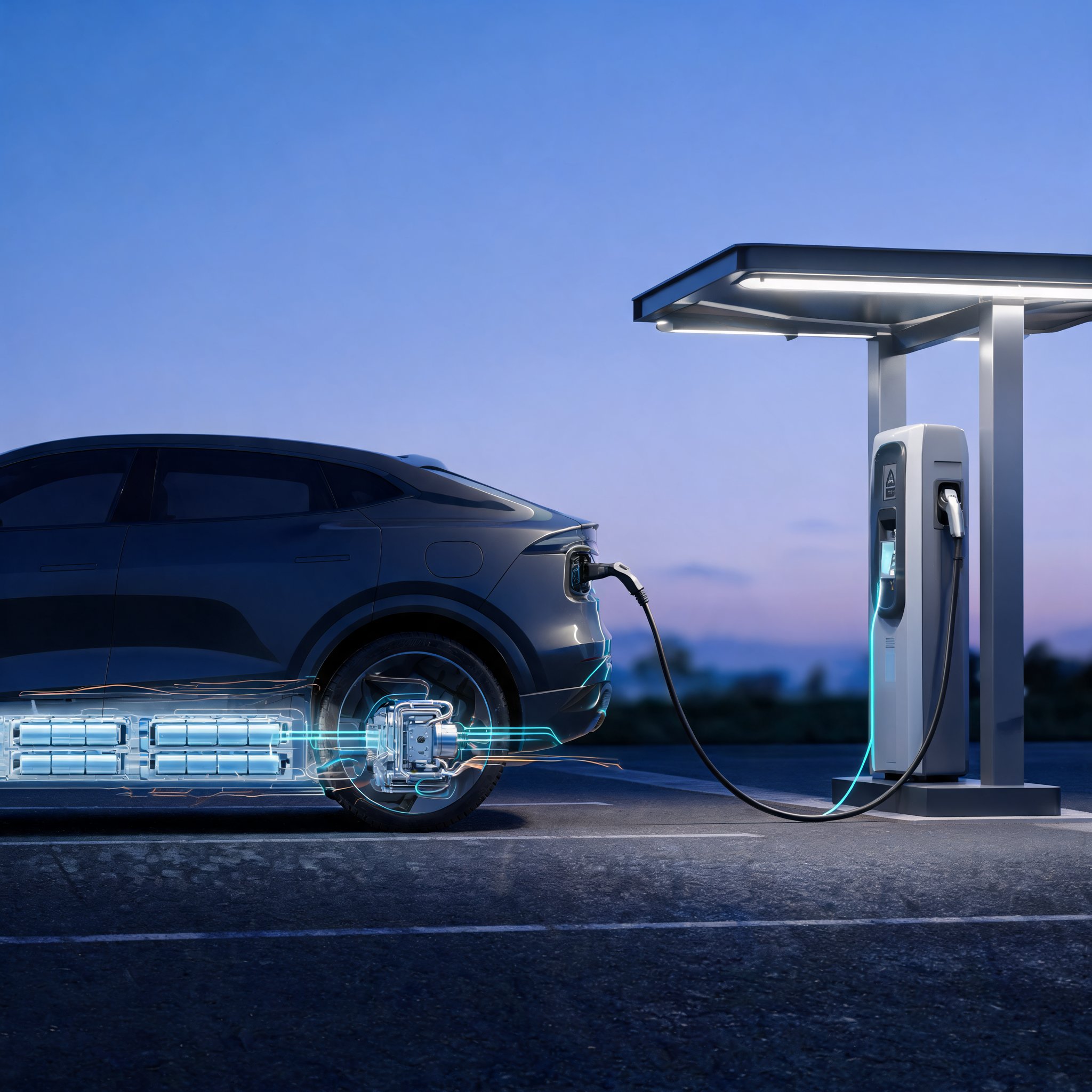
Positioned between the 300 kW base Cayenne Electric and the 630 kW Turbo, the S Coupé delivers up to 400 kW in normal driving and 490 kW with Launch Control, reaching 100 km/h in a claimed 3.8 seconds and a 250 km/h top speed. Like the Macan, it rides on Porsche's Premium Platform Electric (PPE), but for the Cayenne the manufacturer says two central components were redeveloped beyond the Macan's capabilities.
Battery and oil-cooled rear motor
Porsche has integrated the battery more deeply into the vehicle structure and given the S an oil-direct-cooled rear axle motor that is exclusive to the S and Turbo, while the base model uses a water-cooled unit. The Turbo's extra power comes not from a different motor but from a longer version of the same design. An electrically non-conductive oil draws heat directly from the copper windings, whereas conventional water-jacket cooling must first conduct heat to an outer jacket. Porsche puts motor efficiency at up to 98 per cent and cites this better cooling as one reason the S achieves a slightly higher range than the base model despite its greater output.
The pack has a gross 113 kWh, around 108 kWh of it usable, arranged in six modules with 192 pouch cells — a cell-format change from the Macan's prismatic cells. A nickel-rich NMCA cathode of roughly 86 per cent nickel and an anode with six per cent silicon raise energy density by about seven per cent over NMC-811 chemistry. The result stores eight kilowatt-hours more than the Taycan's battery while being around 103 litres more compact. Two cooling plates per module condition the cells from above and below, and Porsche says the pressure fans it uses consume about 15 per cent less energy than conventional suction fans.
Charging: peak power, then Quiet mode
Pre-conditioning is triggered automatically through the Charging Planner once a charging stop is set as a destination; Porsche offers no manual start, so a spontaneous arrival at a fast charger cannot specifically pre-heat the pack. The driver display shows whether the battery is inside its temperature window and what power is currently possible.
In the reviewer's own recording at an EnBW HyperCharger, the session began at nine per cent state of charge (SoC). At 12 per cent, 333 kW was already available, rising to around 360 kW from 13 per cent and peaking at 386 kW at 44 per cent. The data-sheet figure of 390 kW went just unmet, and the limitation was the charger rather than the car: Porsche supplies 390 kW only above 520 amps, while the HyperCharger delivers a maximum of 500. For 400 kW, Porsche specifies an even narrower window of more than 850 volts, a battery temperature of 40 to 42 degrees and an SoC of 45 to 48 per cent.
After the first drop in power, the Cayenne held roughly 290 kW, kept about 270 kW between 60 and 71 per cent, and was still taking 183 kW at 80 per cent. From 10 to 80 per cent took about 16 minutes on the timer — matching the configuration.
The cooling fans are noticeably loud during fast charging and briefly afterwards. Porsche's Quiet Charging mode, which can only be activated manually on the display after charging has started, reduces fan speed, lowers cooling performance and lets the battery heat up sooner, so power is adjusted earlier. In a second session at the same charger, the car was clearly quieter and the 10 to 80 per cent time was still 16 minutes, with a near-identical 385 kW peak. Quiet mode's high plateau ended at 42 per cent, so at 44 per cent it delivered 325 kW against 386 kW in Normal mode. The reviewer cautions that these are single runs and cannot be generalised; outside temperatures were around 20 degrees Celsius. Porsche says a noticeable performance reduction appears only at high starting battery and ambient temperatures, citing a 10 to 80 per cent charge from a 35-degree battery and 45-degree ambient that could take about a minute longer.
Driving dynamics and the weight problem
The standard S Coupé has a kerb weight of 2,560 kilograms. Adaptive air suspension with electronic damper control is standard; the test car added Porsche Active Ride at €8,324, whose active dampers connect to a motor-pump unit on each axle and generate targeted forces at each wheel without mechanical stabilisers. In Comfort, the system can overcompensate for roll and pitch, so the car leans slightly into a curve. Sport and Sport Plus keep the body flat without excessive hardness. Rear-axle steering, at just under €1,700, shrinks the turning circle from 12.7 to 11.6 metres. Regenerative braking is blended into the brake pedal almost imperceptibly; the optional ceramic brake system with black callipers costs €10,100.
Range, consumption and equipment
For the specific configuration, WLTP range is quoted at 616 kilometres, while the S Coupé line reaches up to 669 kilometres; the base model manages up to 661 and the Turbo 637. On mixed routes, consumption ranged from around 20 to 27 kWh/100 km depending on speed, settling near 24 kWh/100 km in everyday mixed driving. With about 108 kWh usable, that equates to roughly 450 kilometres on a full charge, or around 315 kilometres using the 80 to 10 per cent window. These on-board figures cannot be equated directly with WLTP consumption, which includes charging losses. A 22 kW AC charger costs €1,666 and cuts 0 to 100 per cent charging from 11 to 5.8 hours; an 11 kW inductive wireless charging option, orderable since the September 2026 model year, costs €5,117.
Price and positioning
The S Coupé starts at €130,300, but €69,440 of options brought the test vehicle to €199,740. Active Ride, the ceramic brakes and the lightweight sport package alone accounted for €34,589. The review argues that a test car far above the base price is the norm at Porsche, where a modest entry price meets a long, expensive options list. Crucially, the driving experience with active suspension and rear-axle steering cannot be transferred to a standard base S, but the large battery and high DC charging power are part of the basic technical offering. Among rivals, the S is set against the BMW iX5, Mercedes EQS SUV and Audi SQ8 e-tron, with the Audi Q6 e-tron and Porsche's own Macan Electric a class below.
Assessment
The progress of the further developed PPE is most convincing at the fast charger, where the Cayenne S Coupé Electric turns data-sheet figures into reliable real-world performance. Quiet Charging remained a comfort feature rather than a performance one under the conditions tested. On the road, the S combines authoritative propulsion with versatile suspension, though weight, operation and price remain noticeable counterarguments.